Business Visas

Mia Giacomazzi
Kosher Milk Production and U.S. Visa Options: How Dairy Farms Can Bring a Mashgiach, or Kosher Specialist, to the United States
Relevant tags(s):
R-1 Visa
Religious Workers
Kosher
Dairy
For dairy operators, kosher production can create a workforce issue that looks very different from the labor questions farms usually associate with immigration. The worker a dairy needs may not be a milker, veterinarian, or seasonal farmhand.
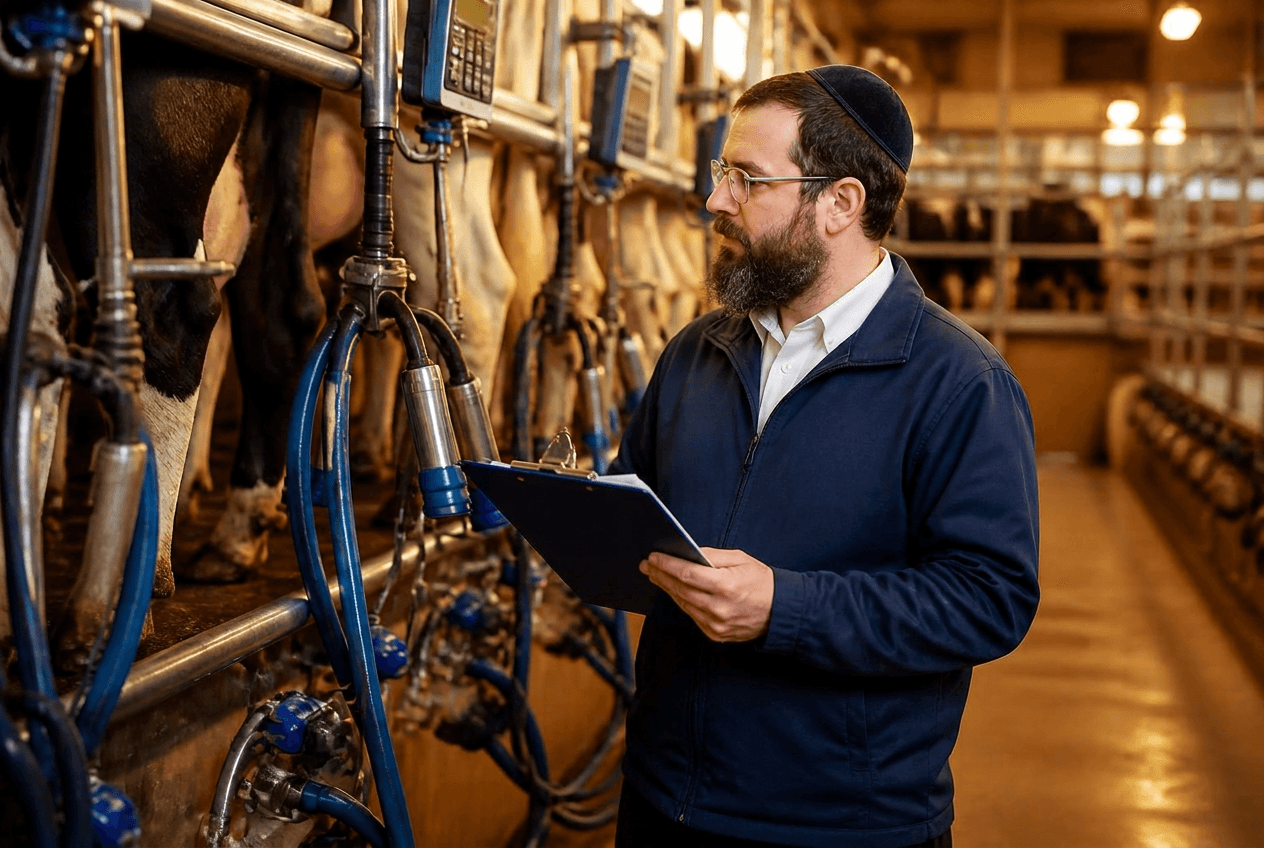
They may be a mashgiach: a trained kosher supervisor whose role is to oversee production so that milk and dairy products receive the required religious certification.
That need can be intensely temporary. A dairy that ordinarily produces conventional milk may schedule a special Cholov Yisroel (or other kosher) production run lasting several days or several weeks, during which a mashgiach or team of mashgichim must remain closely involved with milking, equipment, storage, sealing, and transport.
The Orthodox Union describes part-time Cholov Yisroel farms, where mashgichim come to the farm for a specific production and remain for the duration of that production. In contrast, full-time Cholov Yisroel farms may require supervision year-round.
For U.S. dairy farms that rely on a kosher certification organization or a specialist from Israel or another country, that raises an immigration question. A person may be coming for only a week or two, but if that person will perform services in the United States, the short duration does not eliminate the need for a lawful immigration strategy.
The right visa depends less on the label “kosher supervisor” than on four practical questions: who employs the worker, who pays the worker, what duties the worker will perform, and how long the assignment will last.
Depending on the answers to those questions, an R-1, H-2B, L-1, H-1B, or a narrowly structured B-1 visa strategy may all be worth considering.
Why kosher milk production can require specialized on-site personnel
Not every product labeled kosher requires the same level of supervision. In the United States, some kosher authorities accept ordinary commercial milk based in part on government regulation and inspection.
The Orthodox Union, for example, explains that it follows the view that government inspection of U.S. dairies can satisfy certain concerns associated with unsupervised milk.
Cholov Yisroel production is different. Mashgichim (plural of mashgiach) supervise milking to verify that milk comes only from kosher species and that unsupervised milk is not mixed into the certified supply.
At the end of the process, the mashgiach may supervise transfer from a farm holding tank or silo into a tanker, inspect the tanker, and apply kosher seals. At the processing plant, another mashgiach may verify those seals and supervise production.
That operational reality explains why immigration planning can be integrated into kosher dairy planning. A certification body may have a limited number of people with the required religious training and practical experience, and some may live abroad.
For example, a mashgiach based abroad who travels to U.S.-based dairy facilities for short, intensive kosher production runs must stay close to the farm throughout the process. When a farm or certifier needs that kind of specialist, the immigration structure should be decided before travel is booked.
The first immigration question is: Who is actually employing the mashgiach?
The most important immigration question may not be which visa sounds best. It may be identifying the true employer.
A dairy may contract with a U.S. kosher certification organization, which in turn employs or assigns the mashgiach. Another model might involve a foreign certification organization with a U.S. affiliate. A larger food company may maintain its own kosher-compliance personnel. Those arrangements can lead to very different visa options.
The R-1 religious worker option
This is especially important for the R-1 religious worker classification. USCIS states that an R-1 worker must come to the United States to work as a minister or in a religious vocation or occupation, generally for a bona fide nonprofit religious organization or a qualifying organization affiliated with the religious denomination.
The worker must also have been a member of the religious denomination for at least two years and generally work at least 20 hours per week.
A conventional for-profit dairy will normally not meet the R-1 petitioner requirement merely because it produces kosher milk. That does not necessarily end the R-1 analysis. It may mean the proper petitioner is the religious certification organization that actually employs and controls the mashgiach, while the dairy contracts with that organization for certification services.
Why the R-1 Religious Worker Status May Be the Most Natural Fit for Some Mashgichim
Where the U.S. employer is a qualifying religious organization and kosher supervision is genuinely a religious occupation under the organization’s denominational standards, R-1 can be a logical option.
USCIS has considered mashgiach positions in religious-worker cases. Nonprecedent Administrative Appeals Office decisions have discussed mashgichim as kosher food-production supervisors and examined whether their duties qualify as a religious occupation.
Those decisions are fact-specific and do not mean every mashgiach automatically qualifies. Still, they demonstrate that kosher supervision can fit within the religious-worker framework when the petitioner and duties satisfy the applicable rules.
What to include on an R-1 petition
A well-prepared case should therefore explain the religious character of the work rather than treating the person as a generic quality-control inspector.
The petition may need to describe:
The worker’s authority under the certifying organization
The religious rules the worker applies
The training or standing required by the denomination
The dairy duties and schedule
The compensation arrangement.
Timing matters too. R-1 is petition-based. The U.S. petitioner generally files Form I-129 with USCIS before the worker applies for a visa and travels. Waiting until the kosher run is only a few weeks away can create an avoidable conflict between the production calendar and the immigration process.
Could H-2B Work for a Temporary Kosher Production Assignment?
H-2B is another category worth evaluating in a narrower set of cases, particularly where a U.S. for-profit business is the employer and the work is temporary but does not fit R-1.
The H2-B classification
USCIS describes H-2B as a classification for temporary nonagricultural services or labor. The employer must establish a temporary need based on a one-time occurrence, seasonal need, peak-load need, or intermittent need.
The H-2B visa is sometimes casually described as an “unskilled worker visa,” but that is misleading. The legal test is not whether the job is low-skilled. A specialized kosher-supervision position is not automatically excluded merely because it requires expertise.
Challenges with a H-2B application
The challenge is practical. H-2B generally requires a temporary labor certification from the Department of Labor, recruitment of U.S. workers, and compliance with the program’s numerical limits unless an exemption applies.
For a one-week kosher run, the process may be disproportionate to the assignment. It may make more sense where the dairy or another U.S. employer has a predictable temporary need long enough to justify the certification process.
Other visa options for larger or international dairy farm operations
Some kosher-certification operations are international. If a foreign certification company or religious organization has a qualifying U.S. parent, subsidiary, affiliate, or branch, an L-1 intracompany transfer may be worth examining for a manager, executive, or employee with specialized knowledge.
When to consider an L-1B visa for kosher dairy farms
USCIS generally requires an L-1B specialized-knowledge worker to have worked abroad for a qualifying organization for at least one continuous year within the preceding three years and to be transferring to a related U.S. entity.
For an international certification organization that regularly moves personnel into the United States, this can be more useful than treating every production run as an isolated assignment.
When to consider an H-1B visa for kosher dairy farms
The H-1B visa is another possibility, but it should not be treated as a default mashgiach visa.
The H-1B visa is for specialty occupations that involve highly specialized knowledge and typically require at least a bachelor’s degree in a directly related specialty.
A traditional mashgiach role may involve substantial religious expertise without requiring that kind of academic degree. A broader kosher-compliance, food science, engineering, or quality assurance position that genuinely requires a relevant degree may warrant a different analysis.
Why a standard B-1 business visa is not a shortcut
The fact that a mashgiach may come to the United States for only several days does not mean a normal B-1 business visitor visa automatically works.
The State Department says that B-1 business activity generally does not include performing skilled or unskilled labor in the United States. Ordinary employment is not permitted merely because it is short.
There is a narrow doctrine commonly called “B-1 in lieu of H.” Under the State Department’s Foreign Affairs Manual, 9 FAM 402.2-5(F), some applicants who would otherwise qualify for H-1 or H-3 classification may be admitted as B-1 visitors where the salary continues to come from a foreign employer, the foreign entity has an office and payroll abroad, and the traveler receives no U.S.-source salary other than allowable expense reimbursement.
For a foreign-based kosher specialist, that rule may sound attractive, but it is narrow. The person must actually fit the underlying H-1 or H-3 concept, and the compensation and employer structure must match the Foreign Affairs Manual. A typical mashgiach whose position does not qualify as an H-1 specialty occupation cannot use “B-1 in lieu of H” simply because a foreign company pays the salary.
The broader lesson is that dairies should not treat B-1 or ESTA as catch-all solutions for short assignments. The exact activities should be reviewed before the traveler arrives at a U.S. port of entry.
Kosher certification and immigration should be planned together
For dairy operators, the practical mistake is separating the certification schedule from the immigration schedule. A team may book a kosher production window, arrange cleaning and equipment procedures, coordinate tanker logistics, and reserve a foreign mashgiach before anyone asks whether that individual can lawfully perform the assignment in the United States.
The better process begins earlier. The farm and certifying organization should identify who will supervise the run, where that person is employed, who will pay them, whether the U.S. organization has the appropriate structure to petition, and how much time remains before production begins.
In many cases, the dairy itself will not be the visa petitioner. Its role may instead be to coordinate with a kosher certification organization whose employee performs the supervision.
In other cases, particularly where a large dairy or food company maintains specialized personnel directly, H-2B, H-1B, L-1, or another employer-sponsored category may warrant analysis.
This is also why dairy employers benefit from viewing immigration as a broader workforce-planning tool rather than as something used only for field labor.
How Denizen Immigration can help your dairy farm
Denizen Immigration has written about the expanding immigration options available to dairy operations, including H-2A following the June 2026 dairy policy change and a Midwest dairy case study that shows how multiple visa categories can support different parts of a single operation.
Kosher production is another example of that broader approach. The right answer may be a religious worker visa, a temporary worker strategy, an intracompany transfer, or simply structuring the relationship with a U.S. certification body correctly from the outset.
Denizen Immigration works with dairy and agricultural employers on these kinds of fact-specific workforce questions, helping businesses build an immigration strategy around how the operation actually functions rather than forcing every need into the same visa category.
FAQ: Kosher Milk Production and U.S. Visa Options
What is a mashgiach in dairy production?
A mashgiach is a kosher supervisor responsible for ensuring that production complies with Jewish dietary law and the certifying organization’s standards. In Cholov Yisroel dairy production, duties may include supervising milking, checking equipment, preventing unsupervised milk from entering the supply, sealing holding tanks, and overseeing transfer and processing.
Can a dairy farm sponsor a mashgiach for an R-1 visa?
Usually, a conventional for-profit dairy cannot qualify as an R-1 religious-organization petitioner simply because it produces kosher milk. A qualifying nonprofit religious or affiliated organization may instead employ and petition for the mashgiach while providing certification services to the dairy.
Is every mashgiach eligible for R-1 status?
No. The worker, duties, denomination, petitioner, hours, and compensation structure must satisfy the R-1 requirements. The fact that USCIS has considered mashgiach positions in religious-worker cases does not automatically confer eligibility.
Can a foreign mashgiach visit on B-1 or ESTA for a one-week kosher run?
The short duration alone is not enough. B-1 generally does not authorize ordinary U.S. employment, and Visa Waiver Program travelers are limited to activities that would be permissible in B status. A narrow B-1-in-lieu-of-H theory may exist in certain cases, but only when its specific requirements are met.
Could H-2B be used for kosher supervision?
Potentially. H-2B is not limited to low-skilled jobs, but the employer must establish a qualifying temporary nonagricultural need and satisfy labor-certification and recruitment requirements. Whether it is practical depends on the assignment.
When should a dairy begin planning for immigration during a kosher production run?
As soon as the farm knows foreign personnel may be needed. Petition-based visa categories require lead time, and even a proposed business-visitor strategy should be reviewed before tickets are purchased. Immigration planning should be part of the production and certification calendar, not something handled at the border.